
Many parents search for the biblical meaning of Damian. They hope the name comes from scripture. The truth is a little different. It still holds real spiritual value.
Damian’s roots trace back to Greek, not Hebrew. Its deeper meaning comes from saints, not Bible verses. This guide explains that true story. You will learn where the “divine” feel really comes from.
Damian Name Meaning in the Bible
Damian is a popular boys’ name with deep roots in Greek language and early Christian history rather than in Hebrew scripture itself. It comes from the Greek name Damianos, which is tied to the verb “daman,” meaning “to tame,” “to subdue,” or “to conquer.” Because of this, Damian is most often translated as “to tame” or “the tamer,” carrying an underlying sense of self-control and inner strength. Although the name does not appear as a character’s name within the biblical text, it became deeply associated with Christianity through the early church martyrs Saints Cosmas and Damian. Over centuries, this saintly connection gave the name a strong spiritual and religious identity even though it is Greek, not Hebrew, in origin.
- Damian is a name with Greek roots, not a name found written in the Bible itself.
- Its meaning, “to tame” or “the tamer,” carries themes of discipline echoed in scripture.
- The name’s religious weight comes from Christian saints, not Old or New Testament figures.
- Saints Cosmas and Damian gave the name lasting spiritual and Christian significance.
- Despite no direct biblical mention, it remains widely seen as a name with faith-based heritage.
Is Damian a Biblical Name?
Strictly speaking, Damian is not a biblical name in the sense of appearing in the Old or New Testament texts, since no person named Damian is mentioned in scripture. Its “biblical” reputation instead comes from its close association with early Christian saints and martyrs who lived and were venerated within the Christian tradition. Saint Damian, along with his twin brother Cosmas, was a physician and devout believer in the third century who practiced medicine without charge and was later martyred for his faith. Because of this legacy, Damian became a widely used name throughout Christian Europe, especially among Catholic and Orthodox families. So while you won’t find “Damian” printed in a Bible verse, it carries genuine Christian heritage through sainthood rather than scripture.
- No person named Damian appears anywhere in the Old or New Testament.
- Its “biblical” reputation comes from Christian history, not scripture itself.
- Saints Cosmas and Damian are the true source of its religious association.
- It’s considered a “Christian name” more accurately than a “biblical name.”
- Many faith-based baby name lists include it due to its saintly, not scriptural, roots.
Is Damian or Damien the Correct Spelling?
Both “Damian” and “Damien” are considered correct, and the difference mainly comes down to language and regional preference rather than one being right and one being wrong. “Damian” is the more common English and Greek-based spelling, while “Damien” reflects the French version of the name, which later spread into English usage as well. In Christian history, Saint Damien of Molokai, a Belgian priest famous for his missionary work with leprosy patients, helped popularize the “Damien” spelling internationally. Meanwhile, “Damian” remains the standard spelling in most English-speaking countries today and is the version most commonly found in official records and baby name lists. Ultimately, the choice between the two is a matter of personal or cultural preference rather than correctness.
- Both spellings are correct; the difference is regional, not grammatical.
- “Damian” is the standard English and Greek-based spelling.
- “Damien” reflects the French version of the name.
- Saint Damien of Molokai popularized the French spelling internationally.
- Choice between the two usually comes down to personal or cultural preference.
Damian: Greek Origin and Christian History
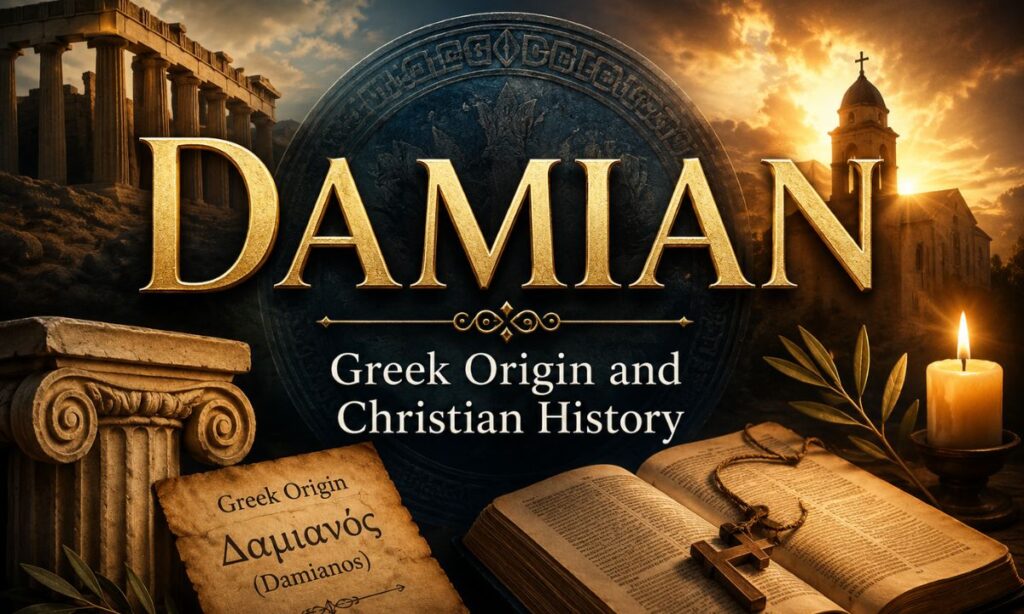
The name Damian traces directly back to ancient Greece, derived from Damianos and rooted in the verb meaning “to tame” or “to subdue,” which reflects qualities like discipline and mastery over oneself. Its Christian significance grew substantially through Saints Cosmas and Damian, twin brothers from the third century who became renowned as healers and were canonized after being martyred for refusing to renounce their faith. Their feast day, celebrated on September 26th, helped spread devotion to the name across the Byzantine Empire and later throughout Western Christendom. As Christianity expanded across Europe, parents began naming sons Damian in honor of these saints, associating the name with healing, charity, and steadfast faith. This blending of Greek linguistic roots with Christian sainthood is what gives Damian its rich and layered historical identity today.
- The name comes from the Greek “Damianos,” rooted in the verb “daman” (“to tame”).
- Saints Cosmas and Damian were third-century twin physicians and healers.
- They were martyred for their Christian faith and later canonized.
- Their feast day, September 26th, spread devotion to the name across Christendom.
- Parents began naming sons Damian in their honor throughout medieval Europe.
Damian in The Bible: Spiritual Significance and Symbolism
Even though Damian does not appear as a named figure in biblical scripture, many people attach spiritual meaning to it because of its Greek root meaning “to tame” or “to subdue,” which echoes biblical themes of self-discipline and overcoming inner struggles. Some interpret the name symbolically as representing a person who tames wild or unruly impulses, aligning with scriptural calls toward humility, patience, and self-mastery. Its strong tie to Saints Cosmas and Damian also lends it symbolism connected to healing, sacrifice, and devotion to God, values that are deeply rooted in Christian teaching. Parents who choose the name today often do so hoping it will inspire qualities of inner strength, compassion, and spiritual groundedness in their child. So while the “spiritual significance” isn’t textual, it’s very much rooted in centuries of Christian symbolism and tradition surrounding the name.
- The name is not textually biblical but is symbolically tied to self-mastery.
- “To tame” or “to subdue” reflects scriptural themes of discipline and humility.
- Its saintly association adds symbolism of healing, charity, and devotion.
- Many parents choose it hoping it inspires inner strength and compassion.
- Its spiritual meaning is rooted in tradition, not direct scripture.
Is Damian a Hebrew Name?
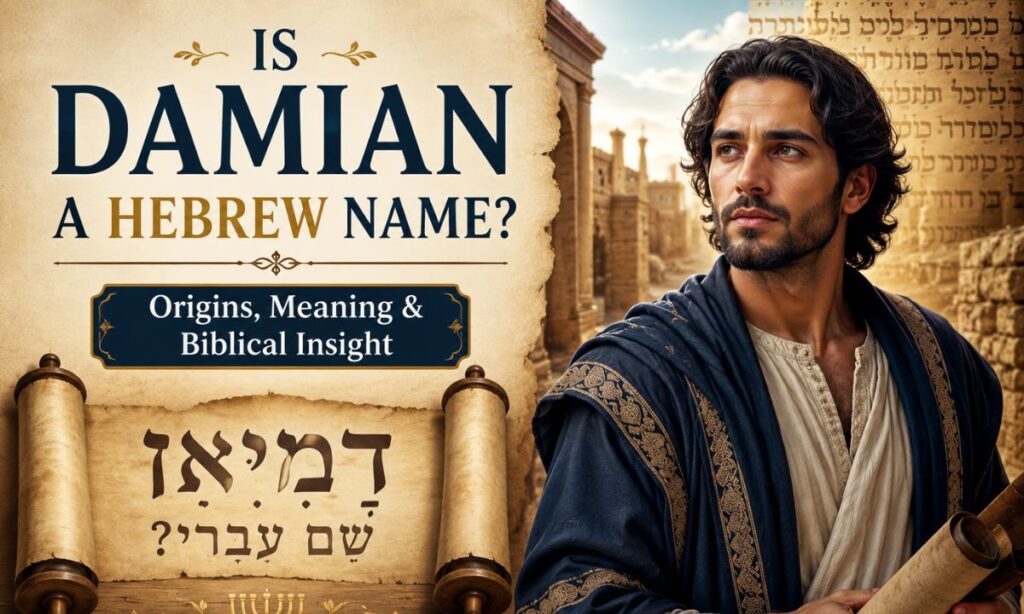
Damian is not a Hebrew name; it is Greek in origin, coming from Damianos and the root verb “daman,” meaning “to tame” or “to subdue.” Unlike many biblical names such as Daniel, David, or Michael, which have clear Hebrew linguistic roots and direct scriptural origins, Damian’s history belongs to the Greco-Roman and early Christian world instead. Its association with the Bible and Christianity comes indirectly, through the veneration of Christian saints rather than through Hebrew scripture or ancient Israelite naming traditions. This distinction is important for parents interested in true Hebrew or Old Testament names, since Damian would fall outside that specific category. Still, its Greek and Christian heritage gives it plenty of historical and religious depth in its own right.
- No, Damian is Greek in origin, not Hebrew.
- Unlike Daniel or David, it has no root in ancient Hebrew language.
- Its Bible connection is indirect, through Christian saints, not Israelite tradition.
- It falls outside the category of true Hebrew or Old Testament names.
- Its religious depth comes from Greco-Christian, not Hebrew, history.
Spiritual Meaning of Damian in the Bible
Since Damian doesn’t appear directly in biblical text, its “spiritual meaning” is really drawn from its Greek etymology and its long Christian legacy rather than scripture itself. The root meaning “to tame” or “to subdue” is often spiritually interpreted as a call to master one’s own desires, temper, or ego in pursuit of a more disciplined, faith-centered life. This idea resonates with broader biblical themes about self-control, humility, and spiritual growth found throughout both the Old and New Testaments. The added influence of Saints Cosmas and Damian, known for healing and selfless service, deepens this spiritual framing by connecting the name to compassion and devotion to others. Altogether, the spiritual meaning attached to Damian is more a product of centuries of Christian tradition than of a direct biblical reference.
- Its spiritual meaning is drawn from etymology and Christian legacy, not scripture.
- “To tame” is often interpreted as mastering one’s ego or desires.
- This idea aligns with broader biblical calls to humility and self-control.
- Saints Cosmas and Damian add layers of compassion and selfless service.
- Overall, its “biblical” meaning is really a product of Christian tradition.
27 Nicknames for Damian and Damien
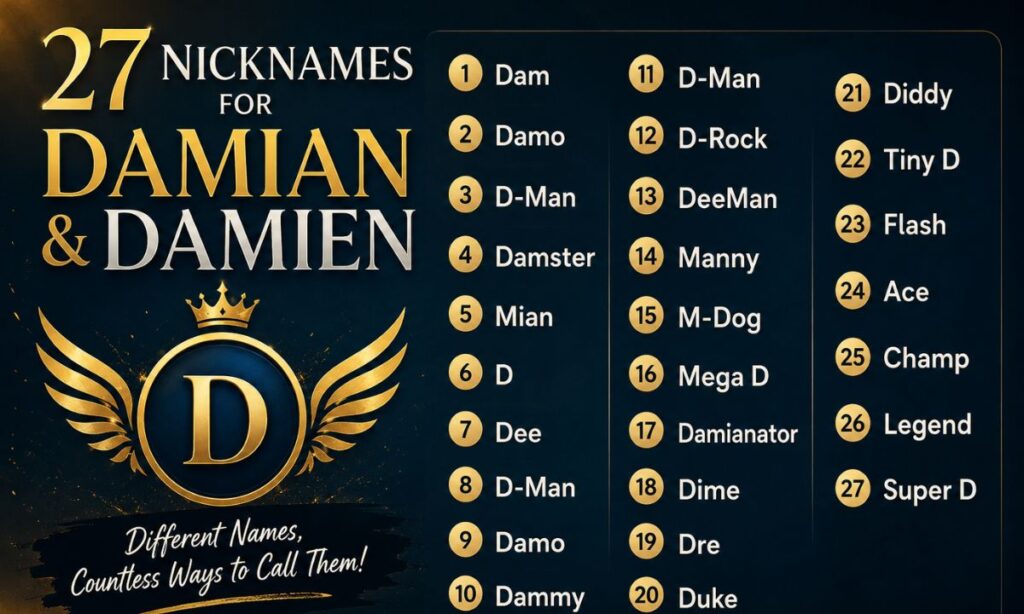
Damian and Damien are already short, punchy names, but that hasn’t stopped families and friends from inventing playful shortened forms and pet names for the people who carry them. Nicknames tend to fall into a few natural groups: simple clippings of the first syllable, softened “-o” or “-y” endings that sound affectionate, and a handful of bolder, more character-driven tags that stick because of personality rather than spelling. Because Damian has no single “official” short form the way Alexander has “Alex,” most of these nicknames are informal and vary by family, region, and era.
Below is a curated list of 27 options ranging from classic to creative, useful for parents, partners, or Damian himself picking a everyday handle. None of these are historically fixed forms — they are simply common and plausible ways the name gets shortened in everyday speech.
| # | Nickname | # | Nickname | # | Nickname |
| 1 | Dami | 10 | Deo | 19 | Damo-Bear |
| 2 | Dame | 11 | Daim | 20 | D-Man |
| 3 | Damo | 12 | Damsy | 21 | Miano |
| 4 | Day | 13 | Damster | 22 | Dami-Boy |
| 5 | Dee | 14 | Big D | 23 | Deeno |
| 6 | DJ | 15 | DamDam | 24 | Damo-Cat |
| 7 | Ian | 16 | Dimi | 25 | Daimon |
| 8 | Mian | 17 | Dae | 26 | Damsky |
| 9 | Deem | 18 | Daimo | 27 | Dami-Cat |
Also See: Biblical Meaning of Amelia
Damian Devil
The pairing of “Damian” with “devil” comes almost entirely from pop culture rather than the name’s actual meaning or history. In the 1976 horror film The Omen and its sequels, a young boy named Damien Thorn is revealed to be the Antichrist, the human embodiment of Satan’s son sent to bring about the apocalypse. The film was a massive commercial and cultural success, and its unsettling, calm-faced “devil child” image became one of the most recognizable horror archetypes of the era.
Because the movie was so widely seen and endlessly referenced, many people who hear the name Damian or Damien still make an automatic mental link to that sinister film character. It’s worth stressing that this connection is purely cinematic — the name’s linguistic root has nothing to do with evil, Satan, or the devil at all. Parents considering the name today often research this association specifically because of lingering pop-culture stigma, even though the etymology tells a very different, much gentler story.
| Aspect | Detail |
| Source of association | The Omen (1976 film) and its sequels/remake |
| Character | Damien Thorn, portrayed as the Antichrist |
| Nature of link | Cultural/cinematic, not etymological |
| Actual name meaning | “To tame” or “to subdue” (Greek) |
| Modern impact | Some naming hesitancy, largely fading over time |
What Is the Meaning of Damian in English?
In English, Damian is treated as a direct borrowing from the Greek name Damianos, and its accepted meaning is “to tame” or “to subdue.” The root traces back to the Greek verb damazo, meaning to conquer, master, or overcome, giving the name connotations of quiet strength and self-control rather than aggression. English-speaking naming guides consistently list “tamer” or “one who subdues” as the core translation, sometimes softened to “gentle strength” in modern baby-name marketing.
The name reached English usage largely through Christian tradition, carried by saints and clergy over the centuries, which helped cement its long-standing popularity in English-speaking countries. Today it is understood in English simply as a strong, classic boys’ name with Greek roots, popular across the UK, Ireland, and the United States.
| Element | Detail |
| Language of origin | Greek (Damianos) |
| Root word | damazo — “to tame, conquer, subdue” |
| English translation | “Tamer” / “the subduer” |
| Gender | Traditionally masculine |
| Common regions of use | UK, Ireland, USA, wider Anglosphere |
Meaning of Damian in the Bible / Hebrew
Damian is not a Hebrew name and does not appear anywhere in the Hebrew Bible or the Torah, so it has no direct Hebrew meaning in the way names like David or Daniel do. Its religious association instead comes through Christian tradition: Saints Cosmas and Damian were twin physicians martyred in the early 4th century and later venerated as patron saints of doctors and surgeons. Because of their fame across the Christian world, the name Damian spread widely through Europe during the medieval period, independent of any Hebrew scriptural source.
Some parents mistakenly search for a “biblical” meaning assuming all traditional-sounding names trace to Hebrew scripture, but Damian’s story runs through Greek language and Christian sainthood rather than the Old or New Testament text itself. If a Hebrew-rooted equivalent is desired, names like Daniel are the closer biblical alternative in sound and tradition.
| Question | Answer |
| Appears in Hebrew Bible/Torah? | No |
| Language of true origin | Greek |
| Religious link | Saints Cosmas and Damian (Christian, 4th century) |
| Closest Hebrew-sounding alternative | Daniel |
| Common misconception | Assumed Hebrew/biblical origin due to religious use |
Damian Name Meaning in Arabic
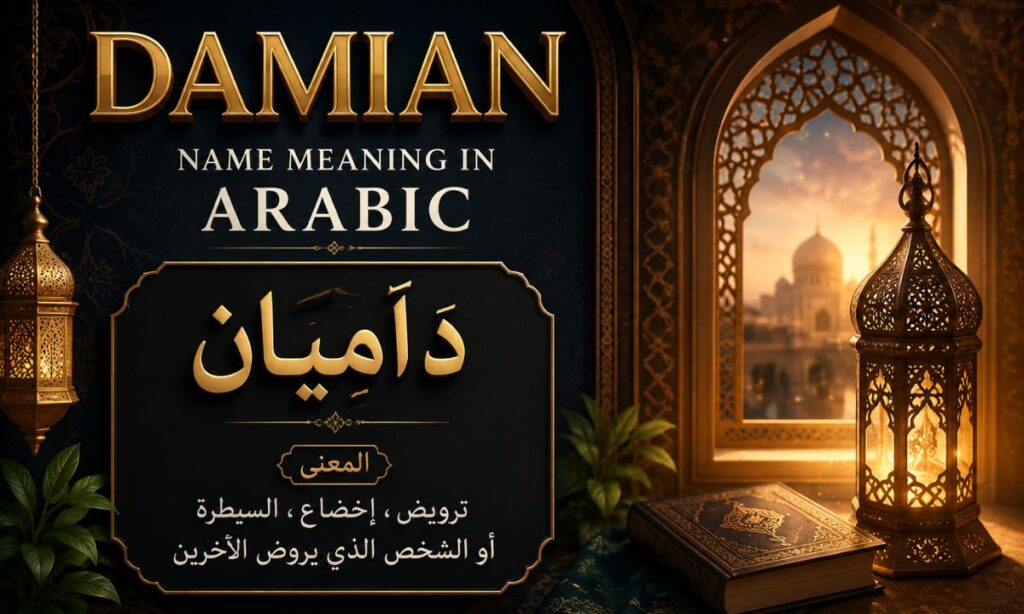
Damian is not originally an Arabic name either; its root remains firmly Greek, but it has been adopted and transliterated into Arabic-speaking communities, most often written as دامیان (Dāmyān) or دامیان (Dāmiān). In these contexts the name generally keeps its inherited Greek meaning of “tamer” or “one who subdues,” rather than gaining a separate native Arabic definition.
It is used occasionally among Arab Christian families, reflecting the same Saints Cosmas and Damian tradition found elsewhere in Christian communities, and less commonly among broader Arabic-speaking populations as an imported Western name. Some modern naming websites claim a distinct Arabic root or attach unrelated Arabic word meanings to the name, but these claims are not well supported by mainstream linguistic sources and should be treated as informal marketing content rather than verified etymology. For families wanting an authentically Arabic name with a similar sound, options like Dāwud (David) or Da’im carry genuine Arabic linguistic roots.
| Element | Detail |
| Native Arabic origin? | No — root is Greek |
| Common Arabic transliteration | دامیان (Dāmyān / Dāmiān) |
| Retained meaning | “Tamer” / “subduer” (inherited from Greek) |
| Typical usage context | Arab Christian families; occasional Western-name adoption |
| Caution | Some sites attach unverified Arabic-root claims — treat with skepticism |
Conclusion
Damian is a strong, simple name. It comes from Greek, not Hebrew or Arabic. It means “to tame” or “to subdue.” Many people know it from The Omen movie too.
There are many ways to shorten it. Dami, Damo, and Dee are popular picks. The name has deep roots in history and faith. It still feels fresh and timeless today.
Also See: Penelope Biblical Meaning
Frequently Asked Questions
What does the name Damian mean?
Damian means “to tame” or “to subdue.” It comes from Greek.
Is Damian a Hebrew name?
No. Damian is Greek, not Hebrew. It is not in the Bible.
Why is Damian linked to the devil?
It’s from the movie The Omen. The character Damien was the Antichrist.
What is a good nickname for Damian?
Dami, Damo, and Dee are common short forms.
Is Damian a boy’s name or girl’s name?
Damian is mostly a boy’s name. It is used worldwide.
What is the Arabic meaning of Damian?
Damian has no true Arabic root. It stays Greek in meaning.
Is Damian a popular name today?
Yes. Damian is still popular in the US, UK, and Ireland.
What is the biblical meaning of Damian?
Damian has no biblical meaning. It is linked to Christian saints, not scripture.
How do you pronounce Damian?
It is pronounced “DAY-mee-an.”
What is the difference between Damian and Damien?
They are the same name. Damien is the French spelling.

3 thoughts on “Damian Meaning in the Bible: Discover Its Powerful Spiritual Significance & Divine Truth”