
If you’re expecting a name straight out of scripture, Penelope might surprise you — she’s not a biblical figure at all, but a heroine from ancient Greek storytelling. Long before it became a nursery favorite, Penelope belonged to Homer, woven into the pages of the Odyssey as the clever, patient wife who waited two decades for her husband to come home.
That’s really the heart of why this name still resonates with so many Christian parents today. It doesn’t need a Bible verse attached to feel meaningful — the story does the work on its own. A woman who kept faith with someone she couldn’t see, who held her household together through years of uncertainty, who outsmarted pressure with patience instead of panic — that’s a story worth naming a daughter after, regardless of which book it came from. In this guide, we’ll walk through where the name truly originates, what it means in Greek, how it connects (loosely, but meaningfully) to Christian values, and whether it’s a name that fits comfortably within a life of faith.
What Is the Biblical Meaning of the Name Penelope
Penelope does not actually appear anywhere in the Bible, and it has no direct Hebrew or Aramaic root, so it carries no formal “biblical meaning” in the way that names like Sarah or David do. The name comes instead from ancient Greek mythology, where Penelope was the loyal wife of Odysseus in Homer’s epics. Christian parents who search for a biblical meaning are often really asking whether the qualities associated with the name — patience, faithfulness, and devotion — line up with biblical virtues, and in that sense many find a spiritual resonance even without a scriptural origin. Some faith-based baby name sites loosely connect Penelope to themes of steadfast love, echoing the kind of devotion praised throughout the Old and New Testaments. It’s worth being clear with family or church communities that this is an interpretive connection rather than an actual biblical reference. If you want a name with a documented biblical root, Penelope isn’t it, but its virtue-based associations make it a popular choice among Christian families anyway.
- Penelope does not appear in any book, verse, or genealogy of the Bible.
- The name has Greek mythological roots, not Hebrew or Aramaic ones.
- Some Christian sites loosely link it to faithfulness and devotion themes found in scripture.
- It’s an interpretive, values-based connection rather than a textual one.
- Many Christian parents still choose it despite the lack of a formal biblical reference.
What Does the Name Penelope Mean in Greek
In Greek, Penelope is most commonly linked to the word “pēnē,” meaning “weaver” or “thread,” a tie to the famous story of Penelope unweaving her loom work each night to delay suitors while waiting for Odysseus. Another theory connects it to “pēnelops,” a type of duck or wading bird mentioned in some ancient Greek sources and legends about her infancy. Scholars aren’t entirely certain which origin is correct, so most reputable sources present both explanations rather than picking one definitively. Either way, the name has carried connotations of cleverness, patience, and resourcefulness since antiquity. The weaving association in particular has made “faithful” or “weaver” the most commonly cited translations today. This dual etymology is part of what makes Penelope such a rich and storied name across cultures.
- Most commonly derived from “pēnē,” meaning “thread” or “weaver.”
- Linked to the myth of Penelope unweaving her loom each night.
- A secondary theory ties it to “pēnelops,” a Greek word for a wading bird.
- Scholars remain divided on which origin is the true source.
- Associated overall with cleverness, patience, and resourcefulness.
Penelope Name Meaning in the Bible
As noted above, Penelope is not a name found in any book of the Bible, in either the Old or New Testament, and it doesn’t derive from Hebrew, Greek koine scripture, or Aramaic sources used in biblical texts. It originates purely from classical Greek mythology through Homer’s “Odyssey,” written centuries before the New Testament and unrelated to Jewish or early Christian naming traditions. Because of this, you won’t find a “Penelope” in any concordance or biblical name dictionary. Some Christian naming guides still include Penelope on lists of “meaningful” names because of its association with loyalty and faithfulness, virtues frequently praised in scripture. This is a values-based connection rather than a textual one, so it’s more accurate to describe it as a name with Christian-compatible meaning rather than a biblical name. Many parents are comfortable with this distinction and choose it anyway for its sound and symbolism.
- Not found in any Old or New Testament book or concordance.
- Originates from Homer’s “Odyssey,” predating the New Testament.
- Unrelated to Jewish or early Christian naming traditions.
- Sometimes included on Christian name lists for its virtue symbolism.
- More accurately described as “meaningful” rather than “biblical.”
Spiritual Significance of the Name Penelope
Beyond religious texts, Penelope has taken on a broader spiritual significance tied to the themes of patience, loyalty, and quiet strength found in her mythological story. She is often held up as a symbol of steadfastness, someone who endured years of uncertainty while remaining true to her values and her marriage. In modern naming culture, this has translated into associations with inner resilience, wisdom, and faithfulness under pressure. Some parents choose the name specifically hoping it will inspire these traits in their daughter. Others are drawn to the quieter symbolism of weaving — the idea of someone who patiently creates and holds things together. While not tied to any specific doctrine, this symbolic weight is part of why Penelope continues to feel meaningful across many spiritual and cultural traditions.
- Symbolizes patience, loyalty, and quiet inner strength.
- Reflects endurance and steadfastness through uncertainty.
- Tied to the imagery of weaving as patient, careful creation.
- Associated with wisdom and resilience in modern naming culture.
- Resonates across multiple spiritual traditions, not just one faith.
Is Penelope a Good Christian Name
Penelope can absolutely work as a Christian name, even though it isn’t biblical in origin, because there’s no requirement that a name appear in scripture to be a fitting choice for a Christian family. Many well-loved names used by Christians today — including classical Greek and Roman names — have non-biblical origins but have been embraced for centuries within church communities. Penelope’s association with faithfulness and devotion aligns naturally with values many Christian parents want to instill in their children. Some churches and denominations place more weight on biblical naming traditions than others, so it’s worth considering your specific community’s expectations. If having a scripturally rooted name matters deeply to you, you might pair Penelope with a biblical middle name for balance. Ultimately, whether it’s a “good” Christian name comes down to personal and family preference rather than any doctrinal rule.
- No requirement exists that a name appear in scripture to suit a Christian family.
- Many classical Greek and Roman names are widely used by Christians today.
- Its faithfulness symbolism aligns with values many Christian parents value.
- Denominational expectations around biblical names can vary, so check your community.
- Pairing it with a biblical middle name is a common way to balance both.
Penelope Name Origin and Variations

Penelope’s origin traces back to ancient Greece, most famously through Homer’s “Odyssey,” where she is the wife of Odysseus and mother of Telemachus. The name has been used across Europe for centuries, gaining particular popularity in English-speaking countries from the Renaissance onward as classical names came back into fashion. Common variations and nicknames include Penny, Nell, Nellie, Lopa, and Pippa, giving families flexibility for everyday use. Other language variants include Penelopa in some Slavic countries and Penelopi in modern Greek. The name has also inspired literary and artistic works far beyond the original myth, reinforcing its lasting cultural presence. Its combination of classical depth and modern versatility is a big part of its ongoing appeal.
- Rooted in ancient Greece through Homer’s “Odyssey.”
- Popular in English-speaking countries since the Renaissance revival of classical names.
- Common nicknames include Penny, Nell, Nellie, Lopa, and Pippa.
- Regional variants include Penelopa (Slavic) and Penelopi (modern Greek).
- Has inspired literary and artistic works well beyond the original myth.
Bible Verse for the Name Penelope
Since Penelope isn’t a biblical name, there’s no scripture verse directly tied to it, but many parents choose a verse that reflects the qualities the name represents instead. Verses about faithfulness and loyalty are popular picks, such as passages describing steadfast love or enduring devotion. Proverbs 31, which describes a woman of noble character, is a common choice for names associated with virtue and diligence. Some families select a verse centered on patience or hope, echoing Penelope’s mythological wait for Odysseus. Others prefer a verse tied to their child’s middle name if it happens to be biblical, using Penelope as the given name and the verse as a companion to the fuller name. This is a personal and symbolic pairing rather than a traditional or doctrinal one.
- No scripture verse is directly tied to the name Penelope.
- Faithfulness and steadfast-love verses are popular substitute picks.
- Proverbs 31 is often chosen for its themes of virtue and diligence.
- Some select verses about patience or hope, echoing the myth’s waiting theme.
- A verse can instead be tied to a biblical middle name paired with Penelope.
Biblical Meaning of the Name Penelope in English
In English-language sources, “biblical meaning” searches for Penelope typically return the same conclusion: the name has no scriptural basis and is instead rooted in Greek mythology. English baby name sites often clarify this while still offering a “spiritual” or “symbolic” meaning tied to faithfulness and devotion. This distinction matters for parents doing research, since conflating mythological and biblical origins can create confusion during baptisms, dedications, or other religious naming ceremonies. Most English Christian resources are upfront that Penelope is a “meaningful” rather than “biblical” name. It remains popular in English-speaking countries regardless of this distinction, often chosen purely for its sound and classical elegance. If accuracy matters to you, it’s fair to describe Penelope as a name with strong character symbolism but no direct English Bible reference.
- English sources confirm Penelope has no scriptural basis.
- Its roots trace to Greek mythology, not the Bible.
- Often labeled “meaningful” rather than “biblical” by naming resources.
- Distinction matters for religious ceremonies like baptisms or dedications.
- Remains popular in English-speaking countries for its sound and elegance.
Penelope Meaning in French

In French, Penelope is spelled the same or sometimes as “Pénélope,” carrying an accented e, and it retains its Greek mythological meaning rather than taking on a separate French definition. The name has been used in France for generations and gained a boost in visibility from the well-known French sitcom character and other pop culture references. French usage often keeps the classical “faithful” or “weaver” association intact, drawing on the same Homeric roots as in English. Pronunciation shifts slightly in French, typically emphasizing the accented syllables differently than in English. It’s considered an elegant, slightly old-fashioned choice in France, similar to how it reads in English-speaking countries. No unique French-language meaning has developed separately from the original Greek origin.
- Spelled “Penelope” or “Pénélope” with an accented e.
- Retains the same Greek mythological meaning as in English.
- Gained visibility from a well-known French sitcom character.
- Keeps the classical “faithful” or “weaver” association.
- Considered an elegant, slightly old-fashioned choice in France.
Penelope Name Meaning in Spanish
In Spanish, Penelope (often written “Penélope” with an accent) keeps its original Greek meaning and mythological association rather than adopting a distinct Spanish-language definition. The name is widely recognized in Spanish-speaking countries, partly due to famous public figures who carry it, which has helped boost its popularity and familiarity. It’s generally understood in Spanish culture with the same connotations of loyalty and faithfulness tied to the Homeric character. Pronunciation in Spanish places stress on the third syllable, “Pe-NÉ-lo-pe,” slightly different from typical English pronunciation patterns. The name is popular across Spain and Latin America and is often chosen for its classic, romantic sound. As with French, there’s no separate Spanish etymological meaning beyond the shared Greek origin.
| Aspect | Detail |
| Spanish spelling | Penélope (with accent) |
| Meaning | Same Greek origin — “weaver” / “faithful” |
| Stress/Pronunciation | Pe-NÉ-lo-pe |
| Popularity | Widely used across Spain and Latin America |
| Notable boost | Popularized by famous Spanish-speaking public figures |
Biblical Meaning of the Name Penelope (KJV)
The King James Version of the Bible, like every other translation, does not contain the name Penelope anywhere in its text, since the name comes from Greek mythology rather than Hebrew or biblical Greek sources. Searching the KJV concordance for “Penelope” will return no results, which is a common point of confusion for people assuming every meaningful name has biblical roots. Some Christian name-meaning sites still list a “KJV meaning” for Penelope by drawing loose thematic parallels to faithfulness verses found throughout the KJV text. This is an interpretive addition rather than something rooted in the translation itself. If you’re specifically looking for a name with confirmed KJV presence, Penelope won’t fit that criteria. It remains, however, a name many Christian KJV-reading families choose for its character symbolism alone.
| Question | KJV Answer |
| Does “Penelope” appear in the KJV? | No |
| Origin of the name | Greek mythology, not Hebrew/biblical Greek |
| Found in KJV concordance? | No |
| Thematic KJV connection | Faithfulness and steadfast-love verses (interpretive only) |
| Suitable for KJV-reading families? | Yes, by symbolism rather than direct reference |
Spiritual Meaning of Penelope
The spiritual meaning most commonly attached to Penelope centers on faithfulness, patience, and quiet inner strength, drawn from her mythological story of waiting loyally for her husband’s return. Many people interpret this as a broader symbol of trust and endurance through uncertainty, values that resonate across multiple faith traditions, not just Christianity. The weaving imagery associated with her name also carries symbolic weight, often interpreted as the patient, careful building of one’s life or relationships over time. Some spiritual and New Age naming resources connect Penelope to themes of intuition and creativity because of this weaving symbolism. It’s a name frequently chosen by parents who want their child associated with steadiness and devotion rather than any single religious doctrine. This flexible, virtue-centered meaning is a large part of why the name feels spiritually significant to so many different people.
| Theme | Symbolic Meaning |
| Faithfulness | Loyalty during long periods of uncertainty |
| Patience | Endurance while waiting for resolution |
| Weaving imagery | Careful, patient building of one’s life |
| Inner strength | Quiet resilience under pressure |
| Cross-tradition appeal | Resonates beyond any single religion |
AlSO SEE: What Does Vanessa Mean in the Bible?
Penelope Meaning in Greek
As covered above, the Greek meaning of Penelope is most often tied to “weaver” or “thread,” referencing her famous loom-weaving trick in the “Odyssey,” though a secondary theory links the name to a type of wading bird from Greek legend. Ancient Greek audiences would have recognized both the mythological character and the layered wordplay embedded in her name. The weaving connection has remained the dominant and most widely cited interpretation in modern name dictionaries. This etymology gives the name a poetic, story-rich quality that few other classical names carry as clearly. It’s part of why Penelope continues to be studied not just as a name but as a piece of literary history. Understanding this Greek root helps explain why so much of the name’s symbolism circles back to patience, cleverness, and devotion.
| Greek Root | Meaning |
| pēnē | Thread / weaver |
| pēnelops | A type of wading bird (secondary theory) |
| Mythological tie | Penelope’s loom-weaving trick in the Odyssey |
| Dominant interpretation | “Weaver” |
| Associated traits | Cleverness, patience, resourcefulness |
Penelope Name Popularity
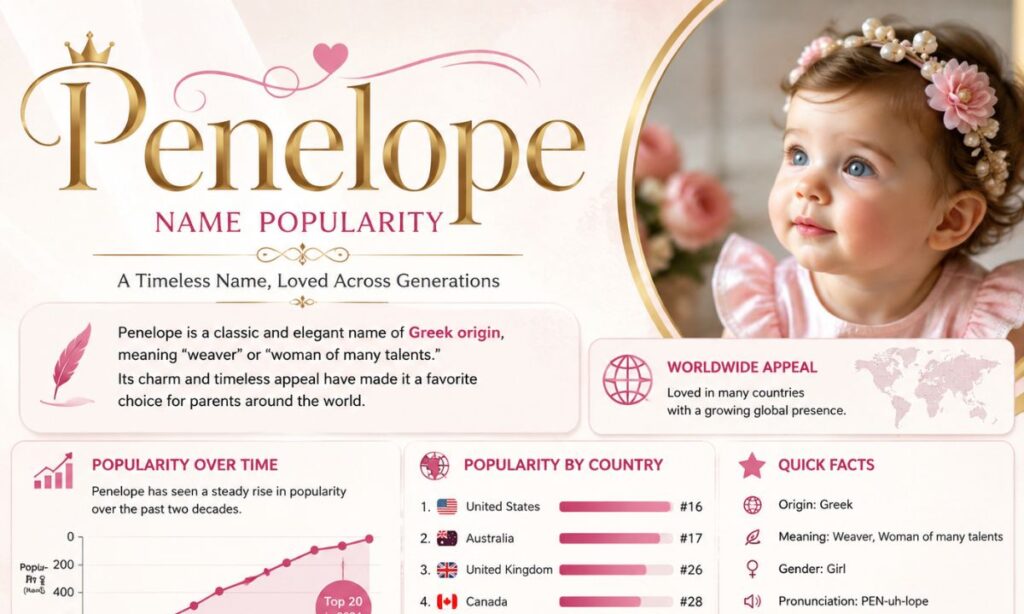
Penelope has seen a significant rise in popularity over the past two decades, particularly in the United States, where it moved from a relatively uncommon classical name into a consistent presence in the yearly top 25 for girls. Its climb has been helped by celebrity baby name choices, classic literary appeal, and a broader cultural trend toward vintage and mythological names. It remains popular across English-speaking countries as well as in Spain, France, and Latin America, where regional variants like Penélope are well established. Nicknames such as Penny have added to its appeal, giving parents a cute, casual option alongside the more formal full name. Popularity naturally shifts year to year, so checking current national statistics gives the most accurate up-to-date picture. Overall, Penelope has moved from niche classical name to a modern favorite while retaining its old-world charm.
| Factor | Detail |
| US ranking trend | Consistently in the top 25 for girls in recent years |
| Key drivers | Celebrity baby names, literary appeal, vintage-name trend |
| Popular regions | US, UK, Spain, France, Latin America |
| Common nickname | Penny |
| Trend | Steady rise over the past two decades |
Conclusion
At the end of the day, Penelope isn’t a biblical name in the strict, scripture-verse sense — but that’s not really the point people are searching for when they ask about her. She’s a name carried by loyalty, patience, and quiet strength, qualities that show up again and again throughout the Bible even though her own story comes from Greek mythology, not Hebrew scripture. Whether you’re drawn to her for the sound, the history, or the meaning woven into her myth, Penelope offers something rare: a name with real literary depth that still feels right at home in a life of faith. And that, more than any concordance entry, is probably why she’s stayed beloved for so long.
ALSO SEE: Eloise Biblical Meaning
Frequently Asked Questions
Is Penelope a name in the Bible?
No, Penelope does not appear anywhere in the Bible. She comes from Greek mythology, most famously as the wife of Odysseus in Homer’s Odyssey.
What does the name Penelope mean spiritually?
Spiritually, Penelope is associated with faithfulness, patience, and quiet inner strength, inspired by her mythological story of loyally waiting for her husband’s return.
What is the Greek meaning of Penelope?
In Greek, Penelope is most often linked to the word for “weaver” or “thread,” tied to the famous scene where she unweaves her loom work each night to delay her suitors.
Can Christians name their baby Penelope?
Yes, many Christian families choose the name Penelope. While it isn’t biblical in origin, its associations with faithfulness and devotion align well with Christian values.
Does Penelope mean faithful?
Penelope is commonly interpreted to symbolize faithfulness, largely because of her mythological reputation for staying loyal to Odysseus during his long absence.
What is a good Bible verse for the name Penelope?
Since there’s no verse tied directly to the name, many parents choose one about faithfulness or steadfast love, such as passages from Proverbs 31, to reflect the name’s meaning.
Is Penelope a French or Spanish name?
Penelope is used in both languages, usually spelled “Pénélope” in French and “Penélope” in Spanish, and it keeps the same Greek meaning in each.
Why is Penelope popular right now?
Penelope has grown popular in recent years due to celebrity baby name choices, its classical literary roots, and a broader trend toward vintage, mythology-inspired names.
What is the nickname for Penelope?
The most common nickname is Penny, though Nell, Nellie, Lopa, and Pippa are also used.
Does the King James Bible mention Penelope?
No, the King James Version does not contain the name Penelope anywhere in its text, since the name has Greek, not Hebrew or biblical, origins.

1 thought on “Penelope Biblical Meaning: Discover Her Powerful Origin, Spiritual Significance & Faithful Purpose”