
When most people picture Satan, they imagine a red figure with horns, a pitchfork, and a tail, ruling over a fiery underworld. But does that image come from the Bible, or from medieval art, folklore, and literature? The truth may surprise you. Scripture describes Satan not as a cartoon villain, but as a real, created, and limited spiritual adversary who answers to God.
In this guide, we look at what the Bible actually says about Satan’s names, character, and role, from Job and Zechariah in the Old Testament to the Gospels and Revelation in the New. We also separate biblical teaching from cultural myths, examine the Lucifer debate in Isaiah 14, and compare how Judaism, Christianity, and Islam understand this figure. Along the way, we cover the biblically accurate demon and the awe-inspiring seraphim, since all three are often misunderstood.
Whether you are a student of Scripture, a curious reader, or someone who wants to separate fact from fiction, this article gives you a clear, balanced, and Bible based answer to one of the most searched questions in Christianity.
Understanding the Biblically Accurate Satan in Scripture
The word “satan” comes from the Hebrew ha-satan, meaning “the adversary” or “accuser.” In the Old Testament he appears rarely, mainly in Job 1-2, Zechariah 3, and 1 Chronicles 21.
In the New Testament he is a clear spiritual enemy of God and humanity. The Bible presents him as a created being, never as God’s equal.
- “Satan” means adversary or accuser in Hebrew
- Job 1-2 shows him appearing before God
- Zechariah 3 shows him accusing Joshua the high priest
- 1 Chronicles 21:1 says he incited David to number Israel
- The New Testament calls him the devil (diabolos, “slanderer”)
- Revelation 12:9 identifies him with the ancient serpent
- Matthew 4 shows him tempting Jesus in the wilderness
- He is a created being, not eternal
- He is not omnipresent, omniscient, or omnipotent
- He needs God’s permission to act (Job 1:12)
- He is called the tempter (Matthew 4:3)
- He is called the evil one (Matthew 13:19)
- Jesus said he was a murderer from the beginning (John 8:44)
- He is described as an enemy to be resisted, not feared (James 4:7)
- His final defeat is promised in Revelation 20
Characteristics of the Biblically Accurate Satan
Scripture describes Satan by his actions and titles rather than his appearance. He deceives, accuses, tempts, and opposes God’s people.
He can disguise himself and work through others. He is powerful but limited and ultimately doomed.
- Father of lies (John 8:44)
- Accuser of the brethren (Revelation 12:10)
- Roaring lion seeking to devour (1 Peter 5:8)
- Disguises himself as an angel of light (2 Corinthians 11:14)
- God of this age, who blinds unbelievers (2 Corinthians 4:4)
- Prince of this world (John 12:31)
- Prince of the power of the air (Ephesians 2:2)
- Leader of a kingdom of spiritual beings (Matthew 12:26)
- Uses schemes and strategies (Ephesians 6:11)
- Quotes Scripture out of context (Matthew 4:6)
- Snatches the word from hearts (Mark 4:15)
- Sows weeds among wheat (Matthew 13:39)
- Can afflict, but only within God’s limits (Job 2:6)
- Cannot snatch believers from Christ’s hand (John 10:28)
- Was disarmed by the cross (Colossians 2:15)
Biblical Versus Cultural Depictions of Satan
Popular culture shows Satan as a red figure with horns, a pitchfork, and a tail, ruling hell. The Bible never describes him this way.
These images came from medieval art, folklore, and literature. Scripture shows him as a defeated enemy awaiting judgment, not a king of the underworld.
- The red skin is not in the Bible
- Horns and a pitchfork are not in the Bible
- The tail is not in the Bible
- The goat-like look borrows from the pagan god Pan
- Medieval mystery plays popularized the comic devil
- Dante’s Inferno shaped the image of Satan frozen in hell
- Milton’s Paradise Lost made him a tragic hero
- Goethe’s Mephistopheles added the charming tempter
- The Bible never says Satan rules hell
- Matthew 25:41 says hell is prepared for the devil, not run by him
- Revelation 12:3 describes a red dragon, but that is symbolic
- Satan is never shown as a comic figure in Scripture
- Cartoon images downplay his real deceptiveness
- Horror films often add details Scripture never gives
- Biblical accuracy means focusing on his works, not his looks
Also See: bible-verses-about-relationships
The Lucifer Debate: Biblically Accurate Analysis
“Lucifer” appears in Isaiah 14:12 in the King James Version, from the Latin Vulgate. The Hebrew phrase helel ben shachar means “shining one, son of the dawn.”
The passage is addressed to the king of Babylon (Isaiah 14:4). Many Christians read it as also describing Satan’s fall, while many scholars see it only as a taunt against a human king.
- “Lucifer” is Latin for “light-bearer”
- The Hebrew word is helel, meaning shining one
- Isaiah 14:4 labels the passage a taunt against the king of Babylon
- The “morning star” imagery was a poetic image of pride
- Early church fathers such as Origen and Tertullian linked it to Satan
- Jerome’s Vulgate popularized “Lucifer” as a name
- Luke 10:18 (“I saw Satan fall like lightning”) is often connected to it
- Ezekiel 28 is a similar passage about the king of Tyre
- Ezekiel 28:14 calls the figure a cherub, which fuels the debate
- Modern translations such as the NIV use “morning star” instead
- Revelation 22:16 calls Jesus the “bright morning star”
- The Bible never uses “Lucifer” as Satan’s personal name
- Pride is the sin highlighted in these passages
- Both readings, human king only or double reference, exist among scholars
- A careful writer should present the debate honestly
Theological Understanding of the Biblically Accurate Satan
Christian theology teaches that Satan is a fallen created spirit who rebelled against God. He is real and personal, not just a symbol of evil.
Yet God remains sovereign, and Satan’s power is limited. Christ’s death and resurrection secured victory over him.
- God created all things, so Satan was created good and later fell
- Pride is the traditional reason for his fall
- Jude 6 and 2 Peter 2:4 speak of angels who sinned
- Satan is a real personal being, not merely an idea
- God’s sovereignty limits his actions (Job 1-2)
- Hebrews 2:14 says Christ destroyed the one holding the power of death
- 1 John 3:8 says Christ came to destroy the devil’s works
- Colossians 2:15 says Christ triumphed over the powers
- Believers are told to resist him (James 4:7)
- The armor of God is the defense (Ephesians 6:10-18)
- Temptation is not the same as sin (Hebrews 4:15)
- Satan cannot read minds, only God knows hearts
- He is not a rival god (no dualism in Christianity)
- His final end is the lake of fire (Revelation 20:10)
- Theology urges vigilance without obsession
Comparative Religious Perspectives on the Biblically Accurate Satan
Different faiths see this figure very differently. In Judaism, ha-satan is mostly a prosecuting angel serving God’s purposes.
In Islam, Iblis is a jinn who refused to bow to Adam. Zoroastrianism has a dualistic evil spirit, Angra Mainyu, which influenced later ideas.
- Judaism: ha-satan acts as a heavenly prosecutor
- Jewish tradition rarely treats him as a rebel against God
- Second Temple texts like Jubilees mention Mastema
- The Dead Sea Scrolls refer to Belial as an evil leader
- Islam: Iblis is named in the Quran
- Quran 18:50 says Iblis was of the jinn
- Iblis refused to prostrate to Adam out of pride
- Islam calls him Shaytan and warns against his whispers
- Christianity sees him as a fallen angel and cosmic enemy
- Zoroastrianism teaches a cosmic struggle between Ahura Mazda and Angra Mainyu
- Scholars debate Persian influence on Jewish ideas during the exile
- Pure dualism is rejected in Judaism, Christianity, and Islam
- All three Abrahamic faiths agree he is a tempter
- All three say his power is limited by God
- Comparing traditions helps readers understand each view fairly
Scholarly Debate: Satan’s Angelic Origin
The Bible never gives a direct story of Satan’s creation and fall. The angelic-origin idea is built from several passages read together.
Traditional readers connect Isaiah 14, Ezekiel 28, Luke 10, and Revelation 12. Critics argue these texts were not originally about Satan.
- No single verse tells Satan’s origin story
- Traditional view: he was a high angel who fell through pride
- Critical view: Isaiah 14 and Ezekiel 28 refer to human kings
- Job 1:6 places Satan among the “sons of God”
- Ezekiel 28:14 mentions a “anointed cherub,” a key proof text
- Revelation 12:7-9 describes war in heaven and a dragon cast down
- Jude 6 speaks of angels leaving their proper place
- The Book of Enoch tells of rebel angels (the Watchers)
- Enoch is not part of the Protestant canon
- Genesis 3 never names the serpent as Satan
- Revelation 12:9 later makes that link explicit
- Second Temple Judaism developed the fall narrative
- Church fathers shaped the standard Christian story
- Reformers like Calvin and Luther largely kept the traditional view
- Honest scholarship distinguishes Scripture from tradition
Cultural Impact of the Biblically Accurate Satan
Satan has shaped art, literature, music, and film for centuries. Many popular ideas about him come from literature rather than the Bible. Understanding the biblical figure helps separate fact from fiction.
- Dante’s Inferno pictured him trapped in ice
- Milton’s Paradise Lost gave him a famous voice and motive
- Goethe’s Faust introduced Mephistopheles
- Medieval cathedrals carved devils and gargoyles
- Renaissance paintings gave him horns and wings
- Folklore blended him with pagan nature gods
- The “deal with the devil” legend is not biblical
- Horror films popularized possession tropes
- Heavy metal and rock used devil imagery for rebellion
- Modern TV shows often portray him as charming or sympathetic
- Halloween costumes reinforce the red-devil look
- Memes and jokes often trivialize spiritual warfare
- Some cultures see him mainly as a symbol of rebellion
- Believers often feel pressure to either ignore or exaggerate him
- Biblical accuracy corrects both extremes
Synthesizing the Biblically Accurate Satan
Put together, the Bible portrays Satan as a real, created, limited, and defeated adversary. He lies, accuses, and tempts, but he answers to God.
He is not a horned cartoon or an equal opposite of God. The biblical picture calls for awareness, humility, and trust in Christ.
- He is a created spiritual being
- He is a real adversary, not a metaphor
- His main weapons are deception and accusation
- His power is limited by God
- He is not omnipresent, so he relies on helpers
- He is not equal to God
- He is a defeated enemy through Christ
- His final judgment is certain
- He is never described as ruling hell
- Popular images are mostly cultural
- “Lucifer” is a debated label, not a clear biblical name
- His angelic origin is traditional but inferred
- Other faiths share parts of the picture but differ on details
- Believers are told to resist, not fear
- The goal of study is truth, not sensationalism
Biblically Accurate Demon (General Nature & Scripture)
The Bible speaks of demons, also called unclean or evil spirits, as spiritual beings opposed to God.
They appear most often in the Gospels, where Jesus casts them out. They are not harmless myths in Scripture, but they are always under Christ’s authority. Their exact origin is not clearly stated.
- Called demons, unclean spirits, and evil spirits
- Deuteronomy 32:17 speaks of sacrifices to demons
- 1 Corinthians 10:20 links pagan sacrifices with demons
- Mark 1:23-26 shows a demon recognizing Jesus
- James 2:19 says demons believe and shudder
- Mark 5 tells of the man with “Legion”
- Matthew 8:31 shows demons begging not to be sent away
- Matthew 12:43 says unclean spirits seek rest in dry places
- Ephesians 6:12 describes spiritual forces of evil
- 1 Timothy 4:1 warns of “doctrines of demons”
- 1 John 4:1 says to test the spirits
- Luke 10:17-20 shows demons submitting in Jesus’ name
- Acts 19:13-16 warns against using Jesus’ name as a magic formula
- Their origin is debated: fallen angels is the most common view
- Another view links them to the Nephilim spirits in Enoch (non-canonical)
Biblically Accurate Demon (Physical Descriptions: The Two Exceptions)
Scripture almost never describes what demons look like. The two main exceptions are in Revelation, and both are symbolic visions.
They are the locust-like creatures of Revelation 9 and the frog-like spirits of Revelation 16. Most other “demon looks” come from art and tradition.
- Most demon passages describe actions, not appearance
- Exception 1: the locust army in Revelation 9:1-11
- They are like horses prepared for battle
- They wear crown-like things on their heads
- Faces like human faces, hair like women’s hair
- Teeth like lions’ teeth
- Breastplates like iron
- Tails with stings like scorpions
- Their king is Abaddon / Apollyon (the destroyer)
- Exception 2: three unclean spirits like frogs in Revelation 16:13
- They come from the mouths of the dragon, the beast, and the false prophet
- They perform signs and gather kings for battle
- Both scenes are apocalyptic imagery, so many read them symbolically
- Leviticus 17:7 mentions se’irim, “goat-demons” or hairy ones, but gives no real description
- Horns, wings, and fangs are mostly later artistic additions
Biblically Accurate Seraphim
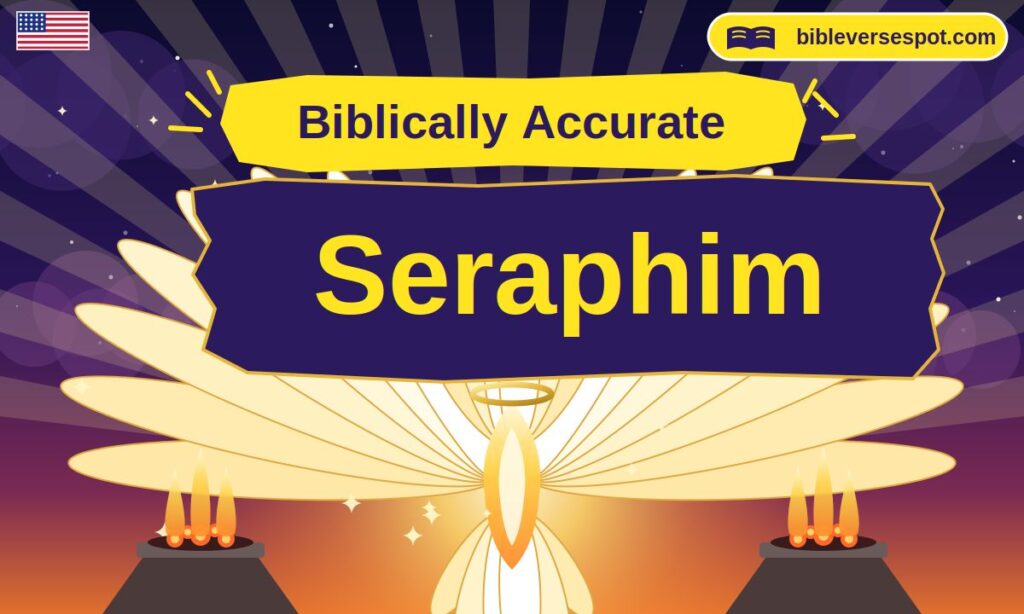
Seraphim appear by name in only one passage, Isaiah 6, where the prophet sees them above God’s throne. They have six wings: two cover the face, two cover the feet, and two are used to fly.
They call out “Holy, holy, holy” and one touches Isaiah’s lips with a burning coal. They are very different from the cute winged babies of modern art.
- Only named in Isaiah 6:1-7
- The Hebrew seraphim means “burning ones”
- They stand above God’s throne
- Each has six wings
- Two wings cover the face
- Two wings cover the feet
- Two wings are for flying
- They cry “Holy, holy, holy” to one another
- Their voices shook the temple foundations
- One seraph touched Isaiah’s lips with a coal from the altar
- This act symbolized cleansing and forgiveness
- They are not the same as cherubim, which have four faces in Ezekiel 1 and 10
- Revelation 4:8 describes similar six-winged living creatures
- Later tradition (Pseudo-Dionysius) ranked seraphim as the highest angelic order
- The chubby cherub image comes from Renaissance art, not Scripture
Conclusion
The biblically accurate Satan, demons, and seraphim look very different from popular culture. Scripture shows Satan as a created, limited adversary who is already defeated in Christ. Demons are spiritual beings under Jesus’ authority, with almost no physical description except in Revelation’s symbolic visions. Seraphim are awe-inspiring six-winged beings who worship God.
Reading carefully, separating Scripture from tradition and art, gives a clearer and more truthful understanding. The aim is neither fear nor fascination, but informed faith and discernment.
Alsop See: powerful-sunday-morning-blessings
Frequently Asked Questions
What does the Bible say about Satan?
The Bible describes Satan as a created spiritual being who opposes God, deceives people, and accuses believers. He is limited by God’s authority and will face final judgment.
What does Satan actually look like in the Bible?
The Bible gives no clear physical description of Satan. The red skin, horns, and pitchfork come from art and folklore. Revelation 12 symbolically calls him a great red dragon.
Is Lucifer the same as Satan?
Many Christians link them through Isaiah 14:12, but the passage is addressed to the king of Babylon. “Lucifer” is a Latin word meaning “light-bearer,” not a clear biblical name for Satan.
Does Satan rule hell?
No. Matthew 25:41 says hell was prepared for the devil and his angels. The Bible presents him as a prisoner to be punished, not a ruler of hell.
Where do demons come from according to the Bible?
The Bible does not clearly explain their origin. The most common view is that they are fallen angels who followed Satan.
What do biblically accurate demons look like?
Scripture rarely describes them. The main exceptions are the locust-like creatures in Revelation 9 and the frog-like spirits in Revelation 16.
What are seraphim in the Bible?
Seraphim are six-winged beings who attend God’s throne in Isaiah 6. The name means “burning ones,” and they proclaim God’s holiness.
What is the difference between seraphim and cherubim?
Seraphim have six wings and appear in Isaiah 6. Cherubim, described in Ezekiel, have four faces and are connected with guarding God’s presence.
Is Satan equal to God?
No. Satan is a created being with limited power. God is sovereign over him.
How do Islam and Christianity differ on Satan?
Christianity teaches he is a fallen angel. Islam teaches Iblis is a jinn who refused to bow to Adam. Both agree he tempts humans.