
Tristan is a name many people link to the Bible or to Greek. It is a popular guess, but it is not correct. The name has no place in Scripture, and it has no Greek root.
Tristan comes from Celtic Britain. Its oldest forms, Drust and Drystan, are Pictish and Welsh. Medieval French writers later changed the spelling, and the famous legend of Tristan and Iseult carried the name across Europe.
So why do so many people search for a Biblical or Greek meaning? Part of the reason is the word “triste,” which means sad, and part is the way baby name sites repeat each other’s mistakes. Greek speakers also use the name today, which adds to the confusion.
Ojos Tristes Meaning
“Ojos tristes” is Spanish for “sad eyes,” and it shares a Latin root with the name Tristan through the word for sadness.
- “Ojos” means eyes in Spanish.
- “Tristes” means sad, the plural of “triste.”
- The phrase is often used in songs and poems.
- It describes a look of sorrow or longing.
- “Triste” comes from the Latin word “tristis.”
- French “triste” comes from the same Latin word.
- This French word shaped how Tristan is spelled today.
- Tristan does not originally mean “sad.”
- The link is a medieval word play.
- Spanish also has the name Tristán.
- Portuguese uses Tristão.
- Italian uses Tristano.
- “Ojos tristes” is not a name or a Greek phrase.
- It simply helps explain why Tristan sounds sorrowful.
- People often search it next to Tristan for this reason.
Tristan Name Meaning
Tristan is usually said to mean “tumult” or “riot,” though many baby name sites claim “sorrowful.”
- The name comes from the Brythonic form Drustan.
- Drustan likely comes from the Pictish name Drust.
- Drust is often linked to the idea of tumult or noise.
- The “sad” meaning came later from the French word “triste.”
- Medieval writers liked this link.
- It fit the tragic story of Tristan and Iseult.
- Both meanings appear in modern name guides.
- The Celtic root is the more reliable one.
- Tristan is a boy’s name.
- It sounds strong and a little romantic.
- Nicknames include Tris and Tristy.
- Variants include Tristen, Trystan, and Tristram.
- Welsh spelling is Drystan.
- The name has been used in Europe for over 800 years.
- Today it is common in English-speaking countries.
Tristan Meaning in Bible

Tristan does not appear in the Bible, so it has no Biblical meaning.
- The Bible was written in Hebrew, Aramaic, and Greek.
- Tristan is a Celtic name from Britain.
- No Bible character is named Tristan.
- No verse mentions it.
- Some baby sites wrongly call it Biblical.
- Always check the source of such claims.
- The name grew in medieval Europe, not the ancient Near East.
- Its legend belongs to Arthurian tales.
- Those tales are not Biblical stories.
- Hebrew has sad-sounding names instead.
- “Marah” means bitter.
- Ben-oni means “son of my sorrow.”
- That name was changed to Benjamin.
- These are the true Biblical links to sorrow.
- Tristan fits Christian families as a saint-like name, but it is not a saint’s name.
Tristan Meaning of the Name
The meaning of Tristan depends on which layer you look at: the Celtic root, the French spelling, or the legend.
- The root layer points to “tumult.”
- The spelling layer points to “sad.”
- The legend layer points to a tragic lover.
- Tristan is also seen as a knight’s name.
- It suggests courage and loyalty.
- It is linked with music, since the legend says Tristan played the harp.
- Parents often like the story more than the meaning.
- The name has a soft, poetic sound.
- It works in many languages.
- It is easy to spell and say.
- It has three common spellings: Tristan, Tristen, and Tristin.
- Tristan is the oldest and most standard form.
- It pairs well with short middle names.
- Its ending sounds like other popular names such as Jordan.
- Its meaning is open, so families can read their own hopes into it.
Tristan Meaning in Greek
Tristan has no meaning in Greek because it is not a Greek name.
- No Greek word matches “Tristan.”
- Greek words for sadness include “lypi” (λύπη) and “thlipsi” (θλίψη).
- “Tristan” does not come from either.
- The “tri” in Tristan has nothing to do with the Greek “tria,” meaning three.
- That is a common mix-up.
- Greek can write the name as Τριστάνος or Τριστάν.
- This is only a spelling, not a translation.
- Greeks borrow the name the way many languages do.
- It is used mostly for foreign people or fictional characters.
- Some sites list Tristan under Greek names by mistake.
- Others make up Greek meanings to fit the search term.
- Treat those claims with caution.
- The name entered Greek culture through translated books and films.
- Its true home is Celtic Britain and medieval France.
- The Greek link is mostly about modern use.
The Greek Etymology of Tristan
The honest etymology of Tristan has no Greek stage at all.
- It starts with the Pictish name Drust.
- It moves into Brythonic as Drustan.
- Welsh and Cornish stories keep this form.
- Old French writers turned it into Tristan.
- They were influenced by the word “triste.”
- “Triste” came from Latin “tristis.”
- Latin “tristis” has no known Greek parent.
- Greek and Latin are related only at a very deep level.
- So there is no direct Greek path.
- Some writers confuse Greek with Latin.
- Others confuse Celtic with Greek, since both are Indo-European.
- Being in the same language family does not make a name Greek.
- Scholars treat Tristan as Celtic French.
- Etymology guides like Behind the Name follow this view.
- Check them before trusting name blogs.
The Historical Origin of the Name Tristan
Tristan comes from early medieval Britain, where it appears as a Pictish and Welsh name.
- Early forms appear in Welsh tales.
- Drystan is named in the Welsh Triads.
- A 6th-century stone near Fowey in Cornwall is called the Tristan Stone.
- Its Latin text names “Drustanus.”
- Some link this stone to the legend.
- The story spread to Brittany and France.
- French poets wrote it in the 12th century.
- Béroul and Thomas of Britain are two early authors.
- A German poet, Gottfried von Strassburg, wrote a later version.
- Thomas Malory included Tristram in his Arthurian book.
- Richard Wagner made it an opera, first shown in 1865.
- The name then spread across Europe.
- Portuguese explorer Tristão da Cunha gave his name to the Tristan da Cunha islands.
- The name grew in English use during the 20th century.
- Film and TV boosted it again.
Tristan in Greek Mythology and Ancient Stories
Tristan is not a figure in Greek mythology.
- Greek myths are far older than the Tristan legend.
- The Tristan story came about 1,500 years later.
- No Greek god or hero has this name.
- Greek myth does have tragic lovers.
- Orpheus and Eurydice is one example.
- Pyramus and Thisbe is another, though it is Roman-told.
- Scholars compare these to Tristan and Iseult.
- The comparison is about theme, not origin.
- Some say the love potion in Tristan echoes older folk tales.
- That is a theory, not proven fact.
- Medieval writers did read classical stories.
- They borrowed ideas freely.
- But the hero and name stayed Celtic.
- Do not believe blogs that place Tristan on Mount Olympus.
- The right category is Arthurian legend.
Cultural Significance of Tristan in Greek History
Tristan has almost no place in Greek history, since it arrived with foreign culture.
- Ancient Greece never used the name.
- Byzantine Greece did not use it either.
- It appears in Greece only after Western literature spread.
- Wagner’s opera reached Greek stages in modern times.
- Greek readers know the story as a European classic.
- Greek translators have rendered the legend.
- The name feels foreign and romantic there.
- It is not tied to any Greek saint.
- Greek Orthodox naming leans on saints’ names.
- Tristan does not fit that tradition.
- Names like Nikolaos, Georgios, and Dimitrios dominate.
- Western names are growing among younger families.
- This growth comes through film, games, and the internet.
- Tristan stays a rare choice.
- Its significance is cultural curiosity, not history.
Also See: happy-saturday-blessings/
The Connection Between Tristan and Greek Language
The only real connection is that Greek can spell and pronounce the name.
- Greek writes Tristan as Τριστάν.
- The sounds fit Greek well.
- “Tr” and “st” are easy clusters in Greek.
- The stress usually falls on the last syllable.
- Greek adds an “-os” ending in older style, giving Τριστάνος.
- This is how Greek treats many foreign names.
- It does not change the origin.
- Greek and English share some Latin-based words.
- Many came through French and science.
- “Triste” has no common Greek cousin in daily use.
- The Greek word “tristis” does not exist.
- Some learners mix up Greek and Latin here.
- Greek teachers point to “lypi” for sorrow.
- The connection is transliteration only.
- Beyond that, the link is a myth.
Tristan vs. Greek Names: Similarities and Differences
Tristan sounds a bit like some Greek names, but the two groups come from different roots and traditions.
- Greek names often come from gods, saints, or virtues.
- Tristan comes from a Celtic legend.
- Alexander means “defender of men.”
- Theodore means “gift of God.”
- Tristan means “tumult” in its oldest form.
- Greek names often end in -os, -as, or -is.
- Tristan ends in an, like Adrian.
- Adrian is Latin, not Greek.
- Both styles are popular worldwide.
- Both feel classic and strong.
- Greek names are common in Greece and Cyprus.
- Tristan is common in the UK, US, and France.
- Greek names often honor grandparents.
- Tristan is usually chosen for style or story.
- The two can live side by side in a family, such as Tristan Nikolaos.
Modern Usage of Tristan in Greek-Speaking Countries
Tristan is uncommon in Greece and Cyprus today, and I found no reliable ranking data to show otherwise.
- Most Greek families choose traditional names.
- Tristan is seen in mixed-heritage families.
- Some children get it from a foreign parent.
- Expat communities use it more.
- Greek social media shows a few examples.
- It may appear in Greek-language media through foreign characters.
- Spelling in Greek is not fully fixed.
- Official records may use Latin letters.
- Nicknames like Tris are easy in Greek.
- Pronunciation is simple for Greek speakers.
- Schools and offices rarely have trouble with it.
- Online name lists exaggerate its popularity.
- For true numbers, check the Hellenic Statistical Authority.
- Expect slow growth, not a boom.
- It will stay a niche, international pick.
Why Parents Choose Tristan: Greek Heritage Perspective?
Parents with Greek heritage who choose Tristan usually do it for sound and story, not for Greek roots.
- It feels modern and international.
- It works in Greek and English.
- It is short and easy to say.
- The legend adds romance.
- Some parents love Wagner’s music.
- Others love Arthurian tales.
- Some like the knight image.
- It avoids the very common Greek names.
- It can honor a foreign relative.
- It suits families living abroad.
- It is easy for non Greek friends to pronounce.
- Some parents add a Greek middle name.
- That keeps heritage in the full name.
- The “Greek name” claim online is wrong.
- Parents should know the true Celtic origin before choosing.
Famous People Named Tristan with Greek Heritage
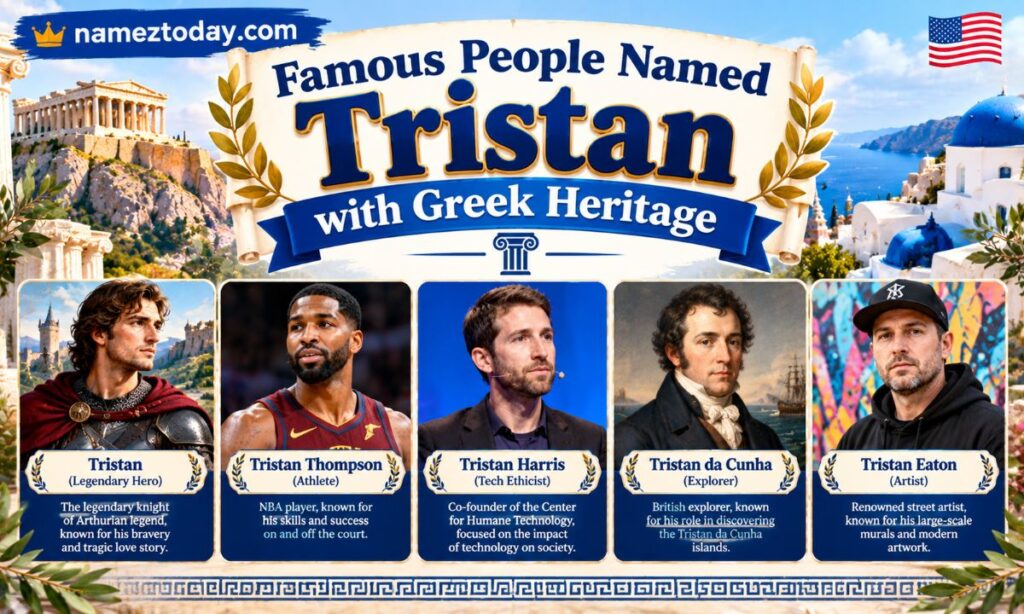
I could not find any well known person named Tristan with confirmed Greek heritage.
- Tristan Tzara was a Dada poet, but he was Romanian-born.
- Tzara was a pen name, not his birth name.
- Tristan Thompson is a Canadian basketball player.
- Tristan Harris is an American tech ethicist.
- Tristan Rogers is an Australian actor.
- Tristão da Cunha was a Portuguese explorer.
- None of these is known as Greek.
- Some lists online add false Greek links.
- Always verify with a trusted biography.
- Greek-American families may have lesser-known Tristans.
- Public records rarely show such details.
- Heritage claims need clear proof.
- Do not assume from the name.
- A person’s family story is private.
- If you know one, cite a solid source.
Tristan Name Variations Across Greek Regions
There are no true regional Greek variations of Tristan, only spellings used across Greek-speaking areas.
- Standard Greek spelling is Τριστάν.
- A longer form is Τριστάνος.
- Cyprus follows the same spellings.
- There are no island specific forms.
- Greek dialects did not develop their own version.
- The name is too new there.
- Diminutives are informal.
- “Tris” is used in Latin letters.
- Some write Tristanos in English.
- Others write Tristanis, but this is rare.
- Compare this to Europe’s real variants.
- Welsh has Drystan.
- Spanish has Tristán.
- Italian has Tristano.
- Greek simply borrows from these.
The Symbolism Behind Tristan in Greek Culture
In Greek culture, Tristan symbolizes foreign romance rather than a native idea.
- It suggests tragic love.
- It recalls medieval knights.
- It carries a sense of longing.
- The “sad” link adds a gentle sorrow.
- Greek culture knows tragedy well.
- Greek theater is built on it.
- So the theme feels familiar.
- The name itself has no Greek symbol.
- It is not tied to any Greek god or virtue.
- It does not appear in Greek proverbs.
- It does not appear in church tradition.
- Greeks may see it as artistic.
- Music lovers link it to Wagner.
- The symbol is borrowed, not inherited.
- That makes it fresh for some families.
Is Tristan a Popular Name in Greece Today?
No, Tristan is not widely popular in Greece, though exact numbers are hard to verify.
- Greek naming is tradition heavy.
- Grandparents’ names are often passed down.
- Saints’ names remain favorites.
- Tristan has no saint’s day.
- This limits its use.
- Foreign names are rising slowly.
- Alexander and Leon fit better as crossover picks.
- Tristan is rarer than both.
- No official top100 list I could confirm includes it.
- Online popularity charts may mislead.
- They often mix countries.
- In the UK and US, Tristan is more common.
- France also uses it often.
- In Greece, it stays unusual.
- That rarity appeals to some parents.
Tristan’s Role in Greek Literature and Poetry
Tristan has no role in ancient Greek literature, and a very small one in modern Greek reading.
- Homer and the tragedians never mention him.
- The legend is medieval.
- Greek translations of the tale exist.
- Wagner’s libretto is known in Greece.
- Greek critics have written on it.
- It is taught in comparative literature.
- Greek poets use broader love themes.
- Tristan is a borrowed figure there.
- Tristan Tzara influenced world poetry.
- His work reached Greek avant-garde circles through Surrealism and Dada.
- This is influence, not heritage.
- Do not claim Greek authors wrote Tristan tales.
- The tale belongs to Celtic and French tradition.
- Greek readers enjoy it as world literature.
- It sits on the shelf with other European classics.
The Greek Influence on Tristan’s Meaning Over Time
Greek influence on Tristan’s meaning is very small and mostly indirect.
- The name stayed Celtic and French for centuries.
- Latin shaped the “sad” idea.
- Latin itself borrowed many Greek words.
- But “tristis” is not one of them.
- Tragedy as an idea came from Greece.
- Medieval writers knew this tradition.
- It may have colored how they told the tale.
- That is a literary link, not a name link.
- The meaning “tumult” has no Greek source.
- The meaning “sad” has no Greek source.
- Modern name sites blur these facts.
- Some add Greek just for traffic.
- Scholarly sources avoid this.
- The best view is Celtic root plus French reshaping.
- Greek only enters through culture and spelling.
Is Tristan a Biblical or Greek Name? Complete Origin Analysis?
Tristan is neither Biblical nor Greek. It is a Celtic name shaped by medieval French.
- Biblical test: it is not in Scripture.
- Greek test: it has no Greek root.
- Celtic test: it matches Pictish Drust and Welsh Drystan.
- French test: it was reshaped by “triste.”
- Literary test: it comes from Arthurian legend.
- Historic test: a 6th century Cornish stone names Drustanus.
- Popular meaning: “sorrowful” is a folk link.
- Older meaning: “tumult” is the likely root.
- Greek can spell it, but did not create it.
- Hebrew has no such name.
- Latin gave the sad link.
- Wagner made it famous worldwide.
- Many blogs repeat errors.
- Trust language dictionaries over baby lists.
- The final answer is clear: Celtic-French.
Conclusion
Tristan began as a Pictish and Welsh name, was reshaped in France, and became famous through a tragic love story. It has no Biblical source and no real Greek roots, although Greek speakers can write and use it today.
If you are choosing the name for Greek heritage reasons, know that it is a modern borrowing there, not an ancestral name. If you like its sound and its story, it is a strong choice. Just keep the facts straight about where it came from.
Also See: good-night-blessings-images/
Frequently Asked Questions
What does the name Tristan mean?
Tristan most likely comes from a Celtic name meaning “tumult” or “riot.” Many people say it means “sad” because of the French word “triste,” but that link came later.
Is Tristan a Greek name?
No. Tristan is not a Greek name. It comes from Celtic Britain and was shaped by medieval French. Greek speakers can spell it, but it has no Greek root.
Is Tristan in the Bible?
No. The name Tristan does not appear in the Bible. It is not a Hebrew, Aramaic, or Biblical Greek name.
What does ojos tristes mean?
“Ojos tristes” is Spanish for “sad eyes.” It is a phrase, not a name, and it shares a Latin root with the word “triste.”
Where does the name Tristan come from?
It comes from early medieval Britain. The oldest forms are Drust, Drustan, and Drystan. The French legend of Tristan and Iseult made it famous across Europe.
Is Tristan a popular name in Greece?
No. Tristan is rare in Greece. Most Greek families choose traditional names tied to saints and family members.
Is Tristan a good name for a boy?
Yes, many parents like it. It is short and easy to say. It also has a romantic, knightly feel from the old legend.