
If you came to Mazikeen through Neil Gaiman’s Sandman comics or the Netflix series Lucifer, you’ve probably wondered how much of her is invented and how much comes from something older. The name isn’t a comic-book coinage — it’s an English spelling of a Hebrew word that shows up in Jewish folklore and rabbinic literature long before anyone put a demon dagger in her hand.
This guide walks through where the name actually comes from, what the Talmud and later Jewish tradition say about the “mazikin,” and how that folklore was reshaped into the scarred, loyal, complicated character fans know today. Along the way we’ll separate the real religious source material from the fictional additions made for the page and screen.
Is Mazikeen In a Bible
Mazikeen herself, as a named character, does not appear anywhere in the Bible. The word she’s named after is a later Hebrew/Aramaic term that grew out of rabbinic literature, not the Hebrew Bible itself.
| Question | Answer |
| Does “Mazikeen” appear in the Hebrew Bible or Old Testament? | No — it is not a biblical name or word |
| Is a related concept in the Bible? | Yes, indirectly — shedim (demons) appear in Deuteronomy 32:17 and Psalm 106:37 |
| Where does “mazikin” actually come from? | Rabbinic and Talmudic literature, written centuries after the Hebrew Bible |
| Is she a biblical figure? | No — she is a folkloric and later a fictional figure |
What the Talmud Says About Mazikin
The Talmud is where the “mazikin” concept actually takes shape, not the Bible. Several tractates describe these as invisible, harm-causing spirits that were part of the Jewish spiritual worldview for centuries. Their origin story is unusually specific: they’re said to have been left unfinished when the first Sabbath began.
- Rabbinic tradition holds that mazikin (also spelled mazzikim) were among the beings created at twilight on the sixth day of creation, just before the first Sabbath
- Because the Sabbath arrived before the work was finished, they were left without physical bodies — spirits rather than flesh
- The Talmud describes them as sharing some traits with angels (such as the ability to move great distances and know the future) and some with humans (they eat, reproduce, and eventually die)
- They’re generally described as invisible and extremely numerous, surrounding people constantly without being seen
- Their role in folklore was mischievous or harmful rather than apocalyptic — accidents, illness, and bad luck rather than cosmic evil
- The name comes from a Hebrew root meaning “to harm” or “to damage,” which is also where the word “mazik” (a rascal or troublemaker) comes from in modern Hebrew and Yiddish
Mazikeen Mythology
Beyond the Talmud, the mazikin sit inside a much wider web of Jewish demonology that includes shedim, lilin, and other spirit classes. This is folklore built up over centuries by different rabbis and mystical texts, not a single fixed story.
- Mazikin are often compared to the Arabic concept of jinn — invisible beings that can help or harm depending on how they’re treated
- Later Kabbalistic sources, especially the Zohar, connect demonic beings to the “klipot,” or spiritual husks that represent impurity
- Some medieval commentators, like the Meiri, reinterpreted mazikin less literally, treating the term as a stand-in for the “evil inclination” (yetzer ha-ra) rather than literal creatures
- Protective customs grew up around the folklore, such as reciting the Shema before bed to ward off harmful spirits
- The mazikin were rarely treated as major villains in this tradition — they’re more like background hazards of daily life than fallen angels or rulers of hell
Understanding the Origin of the Name Mazikeen
The name Mazikeen is not found in the Bible and has no direct biblical origin.
It is commonly associated with Jewish folklore, where “mazikin” refers to harmful or mischievous spirits.
The name became widely known through popular culture, especially the character Mazikeen in Lucifer.
| Element | Detail |
| Root word | Hebrew מַזִּיק (mazik), from a root meaning “to harm” |
| Plural form | Mazikin / Mazzikim / Mazzikin (spelling varies by transliteration) |
| First textual appearance | Mishnah, tractate Avot 5:6 |
| Expanded discussion | Babylonian Talmud, including Chagigah and Berakhot |
| Modern Hebrew/Yiddish use | “Mazik” — a mischievous or rambunctious child |
| Fictional adaptation | “Mazikeen,” first used as a character name by Neil Gaiman in The Sandman (1991) |
Cultural and Spiritual Significance of the Name Mazikeen
Names carry weight in Jewish tradition, and choosing “Mazikeen” for a demon character wasn’t random — it plugs directly into an existing spiritual vocabulary about hidden, harmful forces. The name signals liminality: a being that belongs fully to neither the human world nor the angelic one.
| Layer of meaning | Significance |
| Literal | “One who harms” or “damager” |
| Folkloric | Represents everyday, low-level spiritual danger rather than grand evil |
| Symbolic | Embodies being unfinished or caught between two states of existence |
| Fictional/modern | Used as a name for identity, duality, and loyalty split between two worlds |
Who Is Mazikeen in Sandman?
Mazikeen’s very first appearance in fiction was in Neil Gaiman’s The Sandman comic series, published by DC/Vertigo, well before she was ever adapted for television. She’s introduced there as one of Lucifer’s closest servants during his long reign over Hell.
- She first appears in The Sandman #22 (1991), created by Neil Gaiman and Kelley Jones
- In this original version, half of her face is horribly disfigured, and she wears a mask to cover it
- She serves as Lucifer’s aide and enforcer while he rules Hell, and later helps him after he abandons the throne
- She is introduced as one of the Lilim — the demonic descendants of Lilith — which ties her directly back into the older Jewish folklore around Lilith and shedim
- Her comic-book characterization is more feral and battle-hardened than her later TV counterpart, reflecting the darker tone of the original Sandman universe
Also See: Tristan Name Meaning Bible
What Kind of Demon Is Mazikeen in the Bible?
Since Mazikeen doesn’t appear in the Bible at all, this question is really about what kind of demon her name and folklore background represent, rather than any biblical classification. She’s best understood as a “low-level,” ever-present nuisance-demon type, not a fallen angel or a ruler of the underworld.
| Demon type | Where it appears | How it compares to Mazikeen’s namesake |
| Shedim | Deuteronomy 32:17, Psalm 106:37 | Broader biblical term for “no-gods”; mazikin are a related, later category |
| Mazikin | Mishnah, Talmud (post-biblical) | Invisible, everyday harmful spirits — the direct source of the name |
| Lilin | Rabbinic and Kabbalistic texts | Night spirits linked to Lilith, feeding into the “Lilim” concept used in fiction |
| Fallen angels | Not the Talmudic mazikin category | A different, larger-scale demonic archetype not connected to this name |
Mazikeen of Lilith
In both the comics and the TV series, Mazikeen is written as a daughter of Lilith — the figure from Jewish and Mesopotamian folklore traditionally described as Adam’s first wife. This lineage places her among the “Lilim,” a fictional demon race descended from Lilith.
| Relationship | Detail |
| Mother | Lilith, described in folklore as Adam’s first wife |
| Demon race | The Lilim — Lilith’s children, cast into Hell as a demonic army |
| Notable siblings (in fiction) | Dromos, Squee, Gromos, Belios, among others |
| Fictional twist | Lilith reportedly values a ring made from a stone of Eden over her own children |
Who Is the Father of Mazikeen?
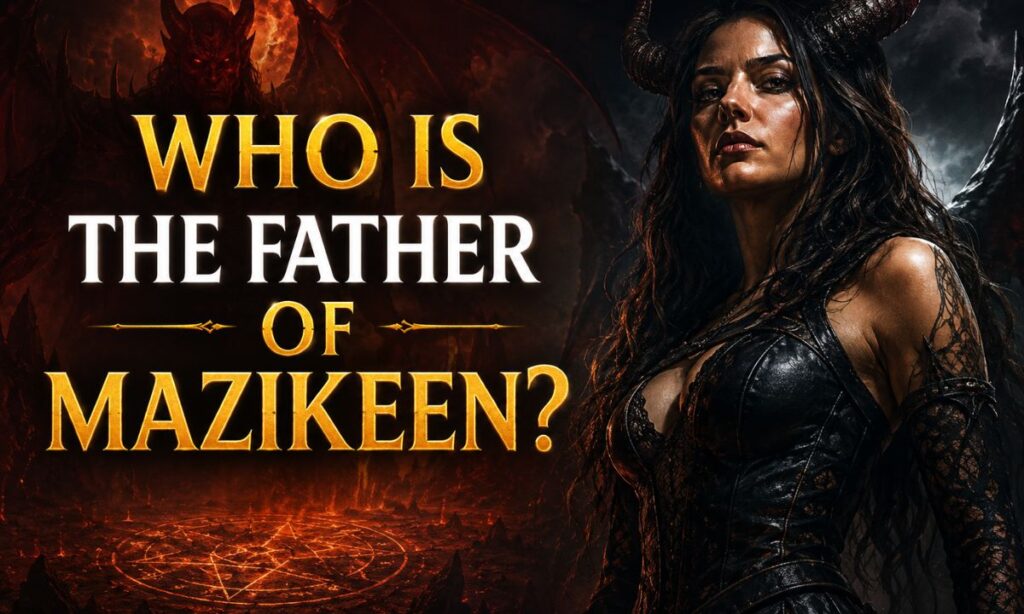
Mazikeen’s father isn’t consistent across every version of the story — the comics name one figure, while the TV series leaves it largely unaddressed. This is a case where the “folklore” ends and pure creative license takes over.
| Source | Claim about her father |
| Lucifer comics | Named as Ophur, a serpent-demon |
| Lucifer TV series | Not clearly identified on screen; the focus stays on her relationship with Lilith |
| Talmudic mazikin folklore | No parentage — the mazikin are described as a created class of spirits, not individuals with named parents |
Her Relationship with Lucifer
Mazikeen’s bond with Lucifer Morningstar is the throughline of the character across every version of the story — comics and TV alike. It shifts from servant-and-master in Hell to something closer to family, friendship, and occasional betrayal on Earth.
- In the comics, she serves as Lucifer’s aide, ally, and lover during his reign in Hell and after he abandons the throne
- In the TV series, she follows him to Los Angeles and works alongside him at his nightclub, Lux
- Over the course of the show she repeatedly shifts loyalty — helping different antagonists at different points — before ultimately siding with Lucifer again
- Their relationship is framed less as romance in the TV series and more as a long, complicated found-family bond
- She eventually builds an independent life on Earth as a bounty hunter, separate from her original role as Lucifer’s enforcer
- Her arc ends with her marrying Eve, moving her story beyond her original tie to Lucifer altogether
Mazikeen Demon Face
One of the most consistent visual details across versions of the character is damage to half of her face — a nod to her demonic, “unfinished” nature that traces back to the folkloric idea of mazikin as incomplete beings.
- In the original comics, the left side of her face is shown as severely disfigured and rotted
- She wears a white mask over that half of her face to hide it from humans
- The TV series generally shows her in fully human form, but referenced the comic look directly in a Season 3 alternate-reality episode
- Her demon form (as opposed to her human disguise) is depicted as far more monstrous in both comics and show
- The disfigured-face motif visually echoes the older folklore idea that mazikin are only partly formed beings, neither fully human nor fully angelic
The Bigger Picture: Mazikeen’s Cultural Impact
What started as a minor category of folk demon in rabbinic literature has become one of the more recognizable demon characters in modern pop culture, largely thanks to two decades of comics and six seasons of television.
- Introduced in The Sandman (1991), later spun off into her own ongoing role in the Lucifer comic series
- Adapted for television in Fox/Netflix’s Lucifer (2016–2021), played by Lesley-Ann Brandt
- Referenced in the wider Arrowverse during the Crisis on Infinite Earths crossover event
- Cited by fans and religious commentators alike as a rare mainstream character drawn directly from Talmudic rather than purely biblical demonology
- Her arc — moving from servant, to enforcer, to independent person with her own relationships and choices — is often highlighted as one of the more complete character transformations in the Lucifer franchise
Also See: Evelyn Meaning in the Bible
Conclusion
Mazikeen is not a Bible character. Her name comes from old Jewish folklore, not scripture. The Talmud describes mazikin as small, unseen spirits. They were left unfinished before the first Sabbath began.
Neil Gaiman took that old idea and built a full character from it. She grew from a comic book demon into a beloved TV favorite. Her story mixes real folklore with pure imagination. That mix is what makes her so interesting to fans today.
Frequently Asked Questions
Is Mazikeen in the Bible?
No. Mazikeen is not in the Bible. Her name comes from Jewish folklore, not scripture.
What does the name Mazikeen mean?
It means “one who harms” or “damager.” It comes from the Hebrew word mazik.
Who is Mazikeen’s mother?
Lilith is her mother. Lilith is a figure from old Jewish folklore.
Who is Mazikeen’s father?
In the comics, her father is Ophur. The TV show does not name her father.
Is Mazikeen a demon or an angel?
She is a demon. She is one of the Lilim, Lilith’s demon children.
Who created the character Mazikeen?
Neil Gaiman created her. She first appeared in The Sandman comics in 1991.
Who plays Mazikeen in Lucifer?
Lesley-Ann Brandt plays Mazikeen. She stars in the Lucifer TV series.
Is Mazikeen in love with Lucifer?
They share a close bond. It is more like family than romance in the show.
What is a mazik in Judaism?
A mazik is a small, unseen spirit. It causes harm or mischief, not major evil.
Why does Mazikeen have half a scarred face?
It shows in the comics. It marks her as an unfinished, in-between being.

1 thought on “Who Is Mazikeen? Biblical & Talmudic Origins of the Demon Behind Lucifer’s Maze”